
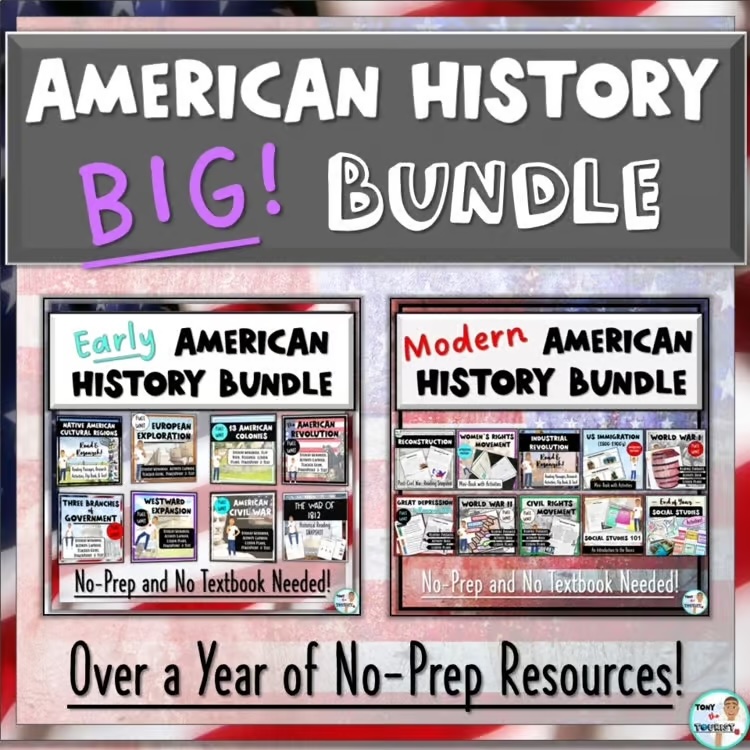
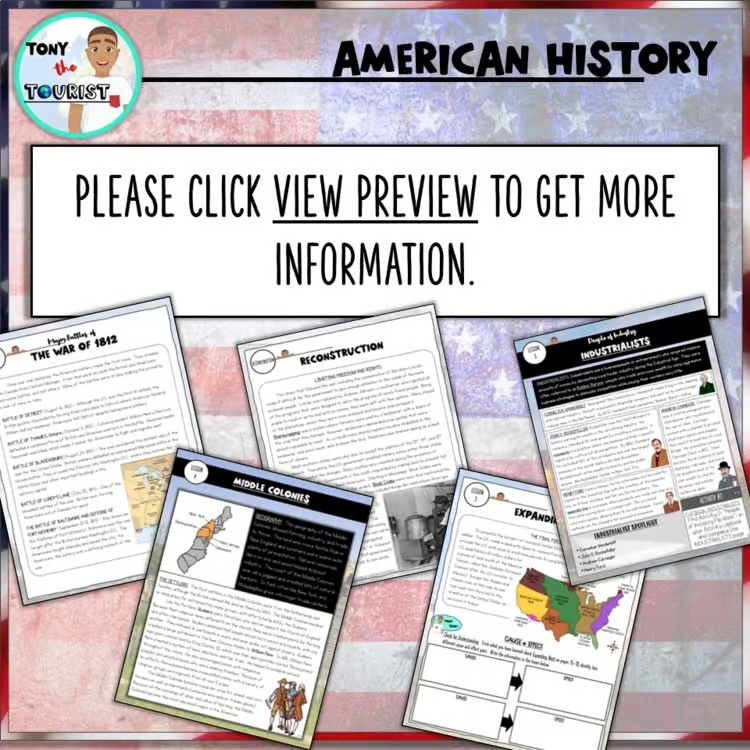
Cover all major American History topics with this No-Prep, No-Textbook needed, Big Bundle! Starting with the Pre-Columbian Era through the Post-Cold War period, every single day of learning is covered for the year (and then some!). Whether you teach 5th, 6th, 7th grade, or 8th grade Social Studies, this bundle will get you through, and can even cover two years for those of you who loop!
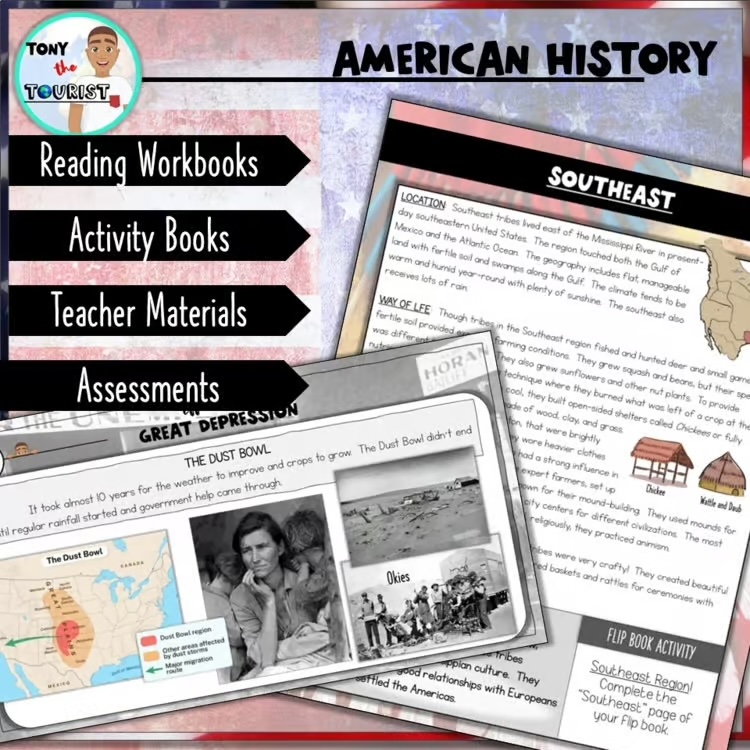
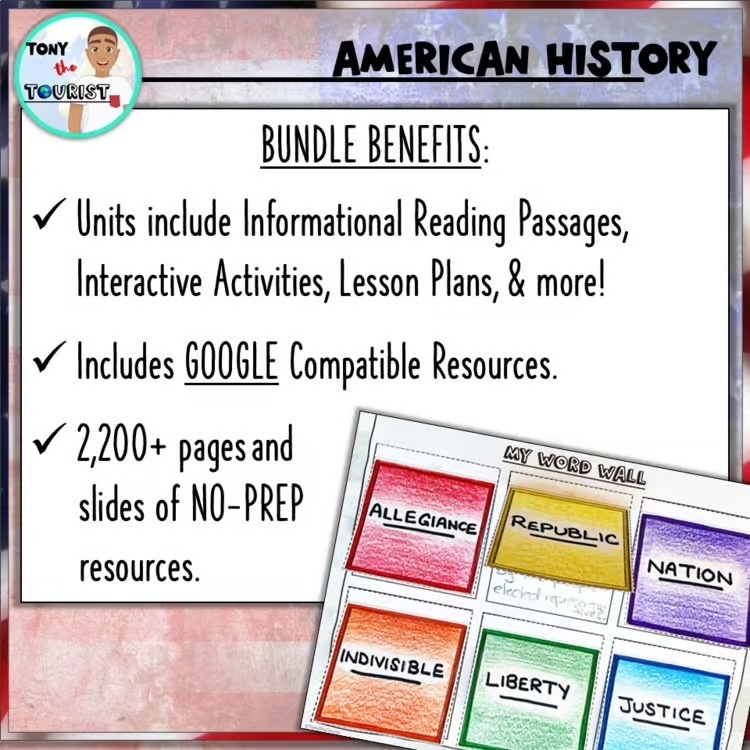
Included: Workbooks with reading passages and comprehension tasks, daily lesson plans, interactive activities, assessments, research options, and more. Units are organized with routines, engagement, and consistent expectations in mind.
*NOTE: This is a GROWING Bundle, and two more Modern American units will be added very soon!
This bundle is intended to make teaching social studies as easy as possible while also increasing literacy development and meeting state standards!
You can check out each of the smaller bundles that have been combined to make this Big Bundle:
MODERN AMERICAN / U.S. HISTORY
>>>>>>>>>>>>>>>>>>>>>>>>>>>>>>>>>>>>>>>>>>>>>>>>>>>>>>>>>>>>>>>>>>>>>>>>>>>>>>>>>>>>>>>>
**UNITS & TOPICS:
SOCIAL STUDIES BASICS (7-10 day Introductory Unit):
- Topics: What is Social Studies (5 Themes, types of Social Scientists). Think like a Social Scientist: 1. Perspective, 2. Fact v. Opinion, 3. Reliable Sources (Primary & Secondary).
LEARNING ABOUT MAPS (7-10 day Introductory Unit):
- Topics: Map Basics (How to read a map, Map components). The Continents & Oceans. Political Maps. Physical Maps. Road Maps. Longitude & Latitude. Hemispheres & Directions.
NATIVE AMERICAN CULTURAL REGIONS (Read & Research Unit):
Topics:
– AN INTRODUCTION TO NATIVE AMERICAN CULTURAL REGIONS
– EASTERN WOODLAND REGION
– SOUTHEAST REGION
– GREAT PLAINS REGION
– SOUTHWEST REGION
– PLATEAU REGION
– NORTHWEST COAST REGION
– CALIFORNIA INTERMOUNTAIN REGION
EUROPEAN EXPLORATION (Full Unit):
Lesson 1: AN OVERVIEW OF EUROPEAN EXPLORATION
– The Beginning
– The Voyage
– Tools and Technology
Lesson 2: SPANISH EXPLORATION
– The Spanish empire and the New World
– Spanish Explorers: Columbus and Balboa
– Spanish Conquistadors: Cortés, Pizarro, and de Soto
Lesson 3: PORTUGUESE EXPLORATION
– Portuguese trade with the east
– Portuguese Explorers: Diaz, da Gama, and Cabral
Lesson 4: FRENCH EXPLORATION
– France and the Northwest Passage
– French Explorers: Verrazzano, Cartier, de Champlain
Lesson 5: ENGLISH EXPLORATION
– England’s exploration of North America
– English Explorers: Cabot and Raleigh
Lesson 6: DUTCH EXPLORATION
– The Netherlands global trade and colonies
– Dutch Explorers: Henry Hudson
Lesson 7: INTERACTIONS WITH INDIGENOUS PEOPLES
– Effect of European exploration on indigenous peoples
Lesson 8: TRANSATLANTIC TRADE
– Slavery and the Middle Passage
– The Columbian Exchange
THIRTEEN AMERICAN COLONIES (Full Unit):
Lesson 1: THE BEGINNING OF COLONIZATION
– European Land Claims
– Columbian Exchange
– Triangular Trade
Lesson 2: SETTLING THE THIRTEEN COLONIES
– Religious Freedom
– The Lost Colony of Roanoke
– Relationships with Indigenous Peoples
Lesson 3: NEW ENGLAND COLONIES
– Geography
– Settlers (Pilgrims, Puritans, John Winthrop, Roger Williams, Anne Hutchinson)
– The Economy
– Culture
Lesson 4: MIDDLE COLONIES
– Geography
– Settlers (Quakers, William Penn)
– The Economy
– Culture
Lesson 5: SOUTHERN COLONIES
– Geography
– Settlers (Jamestown, John Smith)
– The Economy
– Culture
NATIVE AMERICAN / INDIGENOUS INTERACTIONS WITH EUROPEAN SETTLERS (Mini-Book)
Topics:
- Cooperation: The Encounter, Trade, Farming, Cultural Diffusion
- Conflict: Colonies, Pequot & King Philip’s War, Anglo-Powhatan Wars, French & Indian War, American Revolution, Northwest Ordinance lands.
- Competition: Selling lands, the Iroquois, the Sioux Wars, Trail of Tears
AMERICAN REVOLUTION (Full Unit):
Lesson 1: A BRIEF HISTORY: THE COLONIAL PERIOD
– The Thirteen Colonies
– The French and Indian War
– King George III & Parliament
Lesson 2: CAUSES OF THE AMERICAN REVOLUTION
– The Colonists Want Representation
– Taxation Without Representation is Tyranny!
- The Sugar Act
- The Stamp Act
- The Townshend Act & Boston Massacre
- The Tea Acts & Boston Tea Party
- The Intolerable Acts
- The Battle of Lexington and Concord
Lesson 3: THE DECLARATION OF INDEPENDENCE
– The Decision to Declare Independence
– Create a ‘Declaration of Independence’ Mini-Book!
Lesson 4: THE REVOLUTIONARY WAR: MAJOR EVENTS
– The People of the Revolutionary War (Patriots, Loyalists, Red Coats)
– Important Battles (Bunker Hill, Saratoga, Yorktown)
Lesson 5: THE TREATY OF PARIS
– A Victory for the Colonists
– A Fresh Start- The Articles of Confederation
PEOPLE OF REVOLUTION– Research Activity
Included:
– 25 different “People of Revolution” note-making, research pages
– 1 additional blank biography page (so you can add more topics if needed)
– A Teacher Guide that includes a variety of implementation suggestions
– A Jigsaw Activity student worksheet
– A link to Google compatible notes pages
CHARTERS OF FREEDOM (3 Mini-Books- Can be used separately or together):
DECLARATION OF INDEPENDENCE– **Also included in the AMERICAN REVOLUTION Unit
– Founding Fathers and the Committee of Five
– Reasons for Declaring Independence
– Signing the Declaration and Legacy
U.S. CONSTITUTION-
– Constitutional Convention
– The Framers
– Great Compromise
– The Preamble
– The Articles
– The Bill of Rights
– Ratification (Federalists v. Anti-Federalists)
BILL OF RIGHTS-
– Amendments 1-10 Defined
– Legacy
THREE BRANCHES OF GOVERNMENT (Full Unit):
Lesson 1: THE CONSTITUTION OF THE UNITED STATES
– The Supreme Law of the Land, Bill of Rights, and Separation of Powers
Lesson 2: THE LEGISLATIVE BRANCH
– Organization and Legislative Powers
– The Senate and the House of Representatives
Lesson 3: THE EXECUTIVE BRANCH
– Executive Positions, Roles and Powers
– President, Vice President, and Cabinet
Lesson 4: THE JUDICIAL BRANCH
– Judicial Branch responsibilities and organization
– The Supreme Court
Lesson 5: CHECKS & BALANCES
– Checks & Balances Explained with Examples
Lesson 6: GOVERNMENT & CIVICS
– Democracy & Election, Federalism, Citizen Rights and Responsibilities
WAR OF 1812 (Historical Snapshot)
Topics:
- 1. Causes of the War of 1812 (Trade barriers during the Napoleonic Wars, Impressment of Americans, British arming of the Shawnee and other indigenous groups).
- 2. Major Battles (Detroit, Thames, Bladensburg, Lundy’s Lane, Baltimore- Defense of Fort McHenry)
- 3. Important People (Tecumseh, James Madison, Dolley Madison, Andrew Jackson)
- 4. Interesting Facts (Francis Scott Key writes the “Star-Spangled Banner”, the Old Ironsides, Battle of New Orleans after the Treaty was signed)
- 5. Results (Treaty of Ghent, Era of Good Feelings)
WESTWARD EXPANSION (Full Unit)
Lesson 1: WHAT IS WESTWARD EXPANSION?
Lesson 2: THE LOUISIANA PURCHASE
– Purchasing the Louisiana Territory
– Effects of the Louisiana Purchase
– Manifest Destiny
– The Lewis and Clark Expedition
Lesson 3: EXPANDING WEST
– The Annexation of Texas
– The Mexican-American War and Mexican Cession
– The Oregon Territory
– The Final Pieces (Gadsden Purchase, Florida)
Lesson 4: NEW LAND, NEW OPPORTUNITIES
– The Oregon Trail
– California Gold Rush
Lesson 5: THE EFFECTS OF WESTWARD EXPANSION
– Communication and Transportation (Pony Express, Erie Canal, Transcontinental RR)
– Effects on People
– Other Important Effects (The Buffalo, Wild West, Homestead Act)
ABOLITION MOVEMENT (Mini-Book) **Also included in the CIVIL WAR Unit
– Slavery and the evolution of the Abolition Movement
– Harriet Tubman
– John Brown
– Frederick Douglass
– Sojourner Truth
– Harriet Beecher-Stowe
AMERICAN CIVIL WAR (Full Unit)
Lesson 1: AN OVERVIEW OF THE NORTH AND SOUTH
– Different Geographies, Cultures, and Economies
Lesson 2: CAUSES OF THE CIVIL WAR
– Sectionalism
– Expansion and Attempts at Compromise (Missouri, 1850, Kansas-Nebraska)
– The Abolition Movement
– The Election of 1860- Lincoln
Lesson 3: THE AMERICAN CIVIL WAR
– Southern Secession & Fort Sumter
– The Advantages of the Union and Confederacy
– People to Know (Lincoln, Davis, Lee, Tubman, Grant, Barton)
– Major Battles (Bull Run, Shiloh, Antietam, Gettysburg)
– Big Lincoln Moments: Emancipation Proclamation & Gettysburg Address (pg. 18)
– The End of the American Civil War (Surrender at Appomattox)
Lesson 4: RECONSTRUCTION
– Reunifying and Healing the Nation (Amendments 13, 14, and 15)
– The Assassination of Abraham Lincoln
– The Effects and End of Reconstruction (Sharecropping, Jim Crow, Compromise of 1877)
WOMEN’S RIGHTS MOVEMENT (Mini-Book)
Topics:
- Seneca Falls Convention, activism, and achievements- like the 19th Amendment. SIX Women’s Rights Activists are highlighted:
1. Elizabeth Cady Stanton
2. Lucretia Mott
3. Frederick Douglass
4. Sojourner Truth
5. Susan B. Anthony
6. Jane Addams
RECONSTRUCTION (Historical Snapshot)
Topics:
1. A Summary of the American Civil War (Causes, Results)
2. Reunifying and Healing the Nation (Casualty numbers, Lincoln’s Plan, Military Zones, 13th, 14th, and 15th Amendments)
3. Efforts to help Formerly Enslaved People (Freedmen’s Bureau, 40 Acres and a Mule)
4. Limiting Freedoms and Rights (Sharecropping, Black Codes, Jim Crow Laws, Compromise of 1877)
5. The Effects of Reconstruction (Plessy v. Ferguson, KKK, Great Migration, Tulsa Massacre, Ida B. Wells, NAACP, Harlem Renaissance)
THE INDUSTRIAL REVOLUTION (Read & Research)
Lesson 1: The Beginning of Industrialization. (Cotton Gin, Manufacturing, Pre & Post-Civil War Industry)
Lesson 2: The Industrial Revolution. (Inventions- Spinning Jenny, Steam Engine, Telegraph, Mechanical Reaper, Steel Plow. Transportation- Erie Canal, Transcontinental RR. Urbanization)
Lesson 3: People of Industry
* Inventors (George Washington Carver, Alexander Graham Bell, Thomas Edison)
* Industrialists (Vanderbilt, Rockefeller, Carnegie, Ford)
* Laborers (Immigrants, Children, Women, African Americans)
* Immigrants (Irish, Germans, Chinese)
Lesson 4: Effects of Industrialization: (Cheaper goods, medicine and science, poor living and working conditions, unions, women’s rights, Muckrakers & laws)
U.S. IMMIGRATION (Mini-Book)
Topics:
*Industrial Revolution, Push-Pull factors of immigration, Ellis and Angel Islands, Contributions of immigrants, Nativism and discrimination against immigrants. Four immigrant groups are highlighted:
1. Irish
2. Germans
3. Chinese
4. Italians
WORLD WAR I (Full Unit)
Lesson 1- The World Before the War:
- Industrialization (impacts in the U.S. and Europe)
- Imperialism: Europe- Indochina, China, Africa, India. United States- Monroe Doctrine, Spanish-American War, Roosevelt Corollary
Lesson 2- Cause of The Great War:
- MAIN Causes: Militarism, Alliances, Imperialism, Nationalism)
- The Balkans: The “Powder Keg”
- Assassination of Archduke Franz Ferdinand
Lesson 3- The War Begins:
- Germany’s “Blank Check”
- Alliance- Allied and Central Powers
- U.S. Neutrality
- Weapons of War: Artillery, Machine Guns, Tanks, Poison Gas, Submarines
- Trench Warfare
Lesson 4- The U.S. Enters the War:
- Sinking of the Lusitania, Russia Withdrawal, Zimmerman Telegram
- U.S. Propaganda
- Americans Contribute
-Rationing, Victory Gardens, and Liberty Bonds
-Harlem Hellfighters
-Women (Nurses, Rosie the Riveter)
-Code Talkers
-American Pilots: the Lafayette Escadrille
Lesson 5- The End of the War:
- Final Battles (Somme, Marne, Hundred Days Offensive) and the Armistice
- Casualties by country, Armenian Genocide
- Paris Peace Conference: The Big Four and Woodrow Wilson’s Fourteen Points, League of Nations
- The Treaty of Versailles
GREAT DEPRESSION & ROARING 20’S (Full Unit)
Lesson 1- The Roaring Twenties:
- Post WWI World & A Booming US Economy
- Women’s Rights, Jazz Music, Flappers, & Prohibition
- Harlem Renaissance
- Famous 1920’s People (F. Scott Fitzgerald, Bessie Smith, Duke Ellington, Zora Neale Hurston, Charlie Chaplin, Babe Ruth, Louis Armstrong, Clara Bow, Langston Hughes)
Lesson 2- Causes of The Great Depression:
- Overproduction
- Wealth Gap
- Stock Market Crash (Black Tuesday)
- Bank Runs
- Efforts by Herbert Hoover
Lesson 3- Effects of The Great Depression:
- Unemployment
- Bank Failures
- Hoovervilles
- Global Effects
- The Dust Bowl
Lesson 4- FDR and the New Deal:
- Election of 1932
- FDR’s Fireside Chats
- The New Deal (Relief, Recovery, Reform: 12 different New Deal programs)
- The Effects of the New Deal
WORLD WAR II (Full Unit)
Lesson 1- The Rise of Dictators:
- Post-WWI Instability: Bolshevik Revolution, Treaty of Versailles impacts, Weakness of the League of Nations
- Fascism: Benito Mussolini in Italy, Adolf Hitler in Germany
- Emperor Hirohito in Japan
Lesson 2- The War Begins:
- European Theater: German Anschluss & Treaty violation, Munich Agreement, Appeasement, Invasion of Poland, Battle of Dunkirk, Battle of Britain, Operation Barbarossa (invasion of the Soviet Union)
- Pacific Theater: Japan’s need for resources, Nanjing Massacre, Hong Kong, Philippines, and Pacific Islands
- Alliances
- U.S. Neutrality
Lesson 3- The U.S. Joins the War:
- Attack on Pearl Harbor
- Japanese-American Internment Camps
- American War Efforts: Women, Rationing, Code Talkers, Tuskegee Airmen, Douglas MacArthur & Dwight Eisenhower
Lesson 4- The Holocaust:
- Anti-Semitism & the Nuremburg Race Laws
- Kristallnacht
- Nazi Propaganda
- Ghettos and Camps (Warsaw Ghetto)
- The Final Solution & Extermination Camps (Auschwitz-Birkenau)
Lesson 5- The Tide of War Changes:
- Turning Point Battles (Midway, Stalingrad, D-Day)
- Yalta and Potsdam Conferences
- V-E Day: Liberation of Auschwitz, Battle of Berlin
- V-J Day: Manhattan Project, Bombings of Hiroshima and Nagasaki
Lesson 6- The Aftermath:
- Casualties
- The United Nations & Universal Declaration of Human Rights
- Nuremburg & Tokyo Trials
- Zones of Occupation, Israel, Arms Race
CIVIL RIGHTS MOVEMENT (Full Unit)
Lesson 1- A History of Discrimination & Violence:
- Jim Crow Laws, Poll Tax, Literacy Tests, KKK
- 1921 Tulsa Race Massacre
- Plessy v. Ferguson
- White Flight
- Early Black Leaders: Booker T. Washington, W.E.B. DuBois, Marcus Garvey
Lesson 2- The Movement Begins:
- Truman & the Desegregation of the Armed Forces
- Jackie Robinson breaks the color barrier in the MLB
- Brown v. Board, Little Rock Nine, Ruby Bridges
- The Lynching of Emmett Till
- Dr. Martin Luther King, Jr., Malcolm X, Rosa Park, Thurgood Marshall
- Montgomery Bus Boycott
Lesson 3- The Movement Grows: Civil Disobedience:
- Greensboro Four, Sit-ins, SNCC
- Freedom Riders
- MLK: Letter From a Birmingham Jail, March on Washington for Jobs and Freedom
- 16th Street Baptist Church Bombing
- Freedom Summer
- Selma-Montgomery March, Bloody Sunday
Lesson 4- Change is Made:
- 24th Amendment, Civil Rights Act of 1964, Voting Rights Act of 1965
- Loving v. Virginia
- Assassinations- Medgar Evers, Malcolm X, MLK Jr.
- Legacy- Anti-Apartheid Movement, Title IX, Disabled in Action, Shirley Chisolm
5 U.S. REGIONS (Full Unit)
Lesson 1– An Introduction: The Five Regions of the United States
Lesson 2– Northeast:
- Geography (Landforms & Water- Appalachians, Great Lakes, Niagara Falls, Atlantic Ocean, Rivers- Hudson, Connecticut, Potomac. Climate. Natural Disasters)
- Economy (Resources- lumber, stone, iron ore, coal, water, crops. Industries- Lumber, fishing, manufacturing. Goods)
- History (Indigenous Peoples- Algonquin, Iroquois. Settlers- England, Plymouth. Statehood)
- Culture (Cities- Boston, NYC, Philadelphia, D.C., Baltimore. Landmarks- Niagara Falls, Statue of Liberty, Liberty Bell, Time Square, Acadia National Park)
Lesson 3– Southeast:
- Geography (Landforms & Water- Blue Ride Mountains, Coastal Plains, Everglades, Atlantic, Gulf of Mexico, Mississippi River. Climate. Natural Disasters)
- Economy (Resources- fruit, crops, natural gas, oil, coal, lumber. Industries- agriculture, mining, drilling. Goods)
- History (Indigenous Peoples- Five Civilized Tribes. Settlers- England, Spain, Jamestown, St. Augustine. Statehood)
- Culture (Cities- Jacksonville, Charlotte, Atlanta, New Orleans, Nashville. Landmarks- Disney, Kennedy Space Center, Grand Ole Opry, Smokey Mountains)
Lesson 4– Midwest:
- Geography (Landforms & Water- Great Plains, Black Hills, Great Lakes, Rivers- Mississippi, Missouri, Ohio. Climate. Natural Disasters)
- Economy (Resources- granite, gold & minerals, wind and water, iron ore. Industries- Agriculture, shipping, manufacturing. Goods)
- History (Indigenous Peoples- Sioux, Blackfoot, Cheyenne. Settlers- France, French & Indian War. Statehood)
- Culture (Cities- Chicago, Detroit, Minneapolis, St. Paul, St. Louis, Columbus. Landmarks- Mount Rushmore, Cloud Gate, Gateway Arch, Badlands National Park.)
Lesson 5– Southwest:
- Geography (Landforms & Water- Sonoran & Chihuahuan Deserts, Great Plains, Guadalupe Mountains, Gulf of Mexico, Colorado Plateau, Grand Canyon, Rivers- Colorado, Rio Grande. Climate. Natural Disasters)
- Economy (Resources- Oil, natural gas, gold, copper, silver, uranium, sun. Industries- Drilling, Mining, Ranching. Goods)
- History (Indigenous Peoples- Pueblo, Navajo, Apache. Settlers- Spain, Santa Fe. Statehood)
- Culture (Cities- Houston, Phoenix, Dallas, Albuquerque, Oklahoma City. Landmarks- Grand Canyon, Alamo, Petrified Forest, Hoover Dam)
Lesson 6– West:
- Geography (Landforms & Water- Rocky Mountains, Sierra Nevada, Cascades, Lake Tahoe, Redwood Forests, volcanoes, Pacific Ocean, Rivers- Colorado, Missouri. Climate. Natural Disasters)
- Economy (Resources- Lumber, oil, natural gas, gold, copper, silver, zinc, lead, sugar pineapple. Industries- Fishing, Mining, Farming, Ranching. Goods)
- History (Indigenous Peoples- Inuit, Nez Perce, Shoshone, Hawaiians. Settlers- Spain, France, Russia, Asia, Americans. Statehood)
- Culture (Cities- Los Angeles, Denver, Seattle, Las Vegas. Landmarks- Hollywood sign, Space Needle, Arches National Park, Pike’s Peak, Yellowstone, Pearl Harbor, Golden Gate Bridge)
***COLD WAR & THE PROGRESSIVE ERA… Coming Soon!
END-OF- YEAR SOCIAL STUDIES ACTIVITIES:
Included:
US MAPS ACTIVITIES
– Three Map Activities
- States & Capitals
- Physical Features
- 5 U.S. Regions
– Blank, printable maps.
– Student-friendly directions.
– “Check for Understanding” Self-Assessments.
– Sample, completed maps to use as guides.
– A Teacher Guide
- Teacher Outline
- Links to Google compatible resources
- Answer Keys for self-assessments
US SONGS AND ANTHEMS
Three Songs/Anthems:
- Pledge of Allegiance
- Start-Spangled Banner (National Anthem)
- America the Beautiful
– 1-page reading with song/anthem lyrics and background information.
– Scavenger Hunt Reading Tasks:
- “Find Me” short answers.
- “Complete Me” fill-in-the-blank answers.
- “Summarize Me” short-written response.
– “Make your own Word Wall” reading and craft activity.
Teacher Guide
- Teacher Suggestions.
- Link to a Google compatible resource.
- Answer Keys for scavenger hunt tasks.
‘JOURNEY THROUGH HISTORY’ PROJECT OPTIONS:
Project 1- Social Studies on a String:
- Teacher Guide
- Images of Sample Project
- Student Directions
- Templates for three project themes- “Where I’ve Been”, “Who I met”, and “What was Awesome”.
Project 2- Cereal Box Collage:
- Teacher Guide
- Images of Sample Project
- Student Directions
- Student “Brainstorming Page”
Project 3- 3-D Community Project:
- Teacher Guide
- Images of Sample Projects
- Student Directions
- Student “Brainstorming Page”
– Editable Grading Rubric
– Editable Letter Home to Parent/Guardian
Extras:
SOCIAL STUDIES ACCESSORIES PACKAGE
– Great addition to your lesson planning and student experiences!
SOCIAL STUDIES THEMES: CLASSROOM AND STUDENT BINDER POSTERS
READING SKILLS & COMPREHENSION- CLASSROOM AND STUDENT BINDER POSTERS
**Friendly Reminder: LICENSING TERMS: This purchase includes a license for one teacher only for personal use in their classroom. Licenses are non-transferable, meaning they cannot be passed from one teacher to another. No part of this resource is to be shared with colleagues or used by an entire grade level, school, or district without purchasing the proper number of licenses. If you are a coach, principal, or district interested in transferable licenses to accommodate yearly staff changes, please contact me for a quote at tonythetourist1@gmail.com. Thank you for respecting my terms!
>>>>>>>>>>>>>>>>>>>>>>>>>>>>>>>>>>>>>>>>>>>>>>>>>>>>>>>>>>>>>>>>>>>>>>>>>>
“Tony the Tourist” is part of a growing series that offers a fun and interactive way to teach social studies to upper elementary and middle school students. FOLLOW ME, and you will be the first to know about new resources, freebies, and where Tony is going next!
Reviews are helpful! Go to “My Purchases” in your account, find this resource, and select the option to leave feedback. In return, you will receive “TpT Bucks” to use towards future purchases… it’s a win-win!
*Please email me if you have questions about this curriculum: tonythetourist1@gmail.com